Closing the gap between productivity and wages
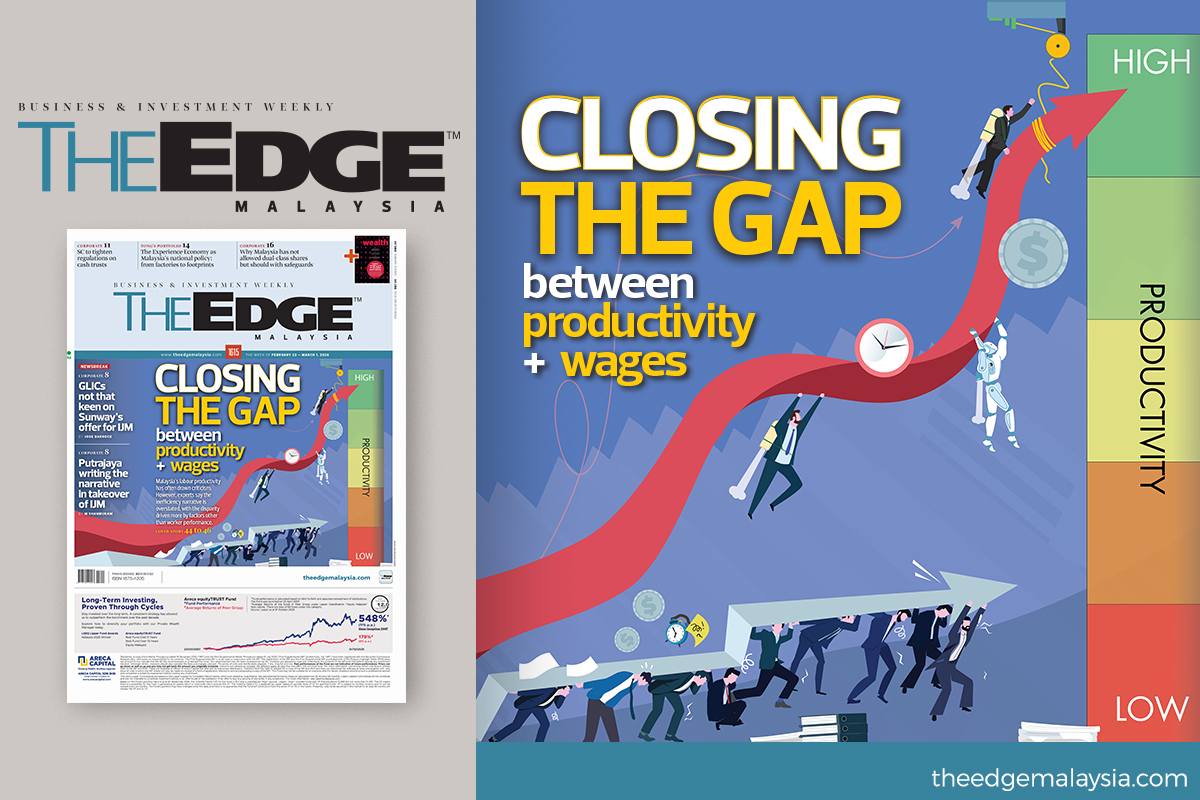
KUALA LUMPUR (Feb 21): Malaysia’s workforce is often labelled as less productive than those in other countries — a perception that continues to spark debate among workers and employers. But is this perception accurate?
“As a developing nation, Malaysia’s labour productivity has scope to improve, but it does not lag regional and global benchmarks to the extent often suggested,” says MARC Ratings Bhd chief economist Ray Choy.
Labour productivity is typically measured as gross domestic product per person employed or per hour worked, according to the International Labour Organization (ILO). This metric is significant, as it often serves as a reference for wage setting.
Simply put, the slower the increase in labour productivity, the slower the wage increase. This in turn affects an employee’s propensity to consume, which then affects the economic growth of the nation.
On the labour productivity scoreboard, measured in constant international dollars at purchasing power parity in 2025, Malaysia sits above the middle point among 186 countries, at int-$30.40 per hour worked in 2025, according to ILO.
Compared with countries that top the list by the same measure — Ireland (int-$164.70), Luxembourg (int-$159.50), Norway (int-$125.60) and even Singapore (int-$100.40) — Malaysia does seem to be lagging far behind in labour productivity. (An international dollar [int-$] is a hypothetical currency equal to US$1, with the same purchasing power anywhere in the world and adjusted for differences in living costs and price changes over time.)
This vast disparity between Malaysia and the countries ranked among the highest in labour productivity globally has more to do with structural differences rather than a behavioural trait, experts say.
Get the full story in the Feb 23 issue of The Edge Malaysia weekly.
Save by subscribing to us for your print and/or digital copy.
P/S: The Edge is also available on Apple's App Store and Android's Google Play.
The content is a snapshot from Publisher. Refer to the original content for accurate info. Contact us for any changes.
Comments
